Fortescue Ltd says it is accelerating delivery of the world’s first industrial and fully integrated green energy grid dedicated to eliminating fossil fuels from large-scale industry, at a scale comparable to a city, adding that it intends to replicate and commercialise this technology wherever it is invited.
The company is targeting diesel elimination in particular – a fuel that is 100% imported and subject to extreme price volatility, unreliability and hardship – that also costs the taxpayer billions in subsidies.
Unlike other large renewable hubs, which feed intermittently into national or other power systems, Fortescue’s off-grid system will be the largest of its kind dedicated to decarbonising major industry, around the clock, the company claims.
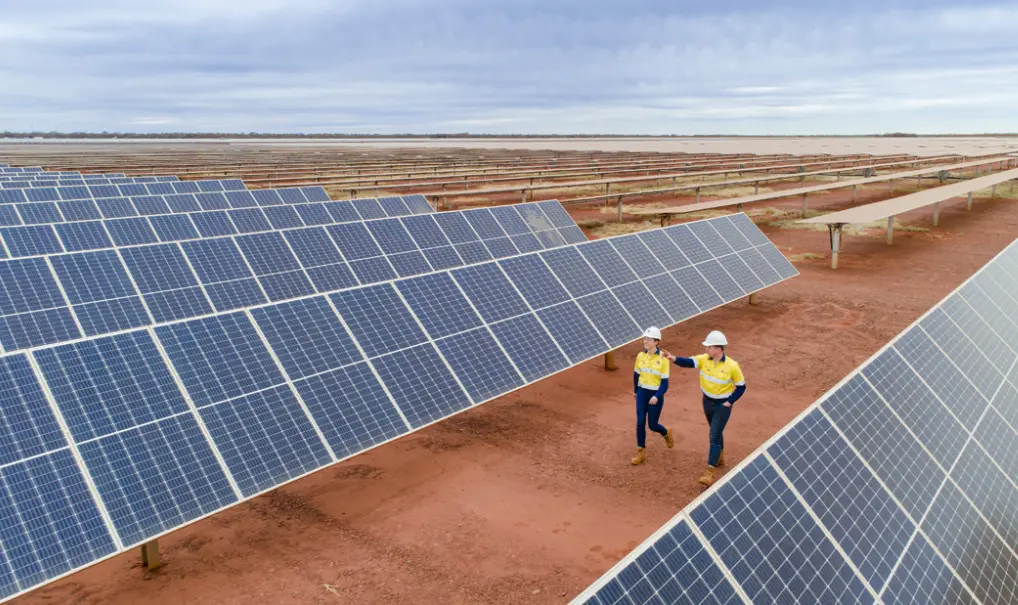
By early next year, the company expects to complete 290 MW of installed renewable capacity to meet the fixed energy requirements of its ore processing facilities, enabling daytime “green processing” across its Pilbara operations. Later that year, the system will power all of Fortescue’s operations for 24-hour periods without fossil fuels.
This is well ahead of previously announced Real Zero plans, targeting December 2030.
Fortescue is expecting full completion of its Pilbara green grid by the end of 2028, in line with Real Zero. This includes 1.2 GW of solar capacity, more than 600 MW of wind generation, and 4-5 GWh of battery energy storage.
The company said: “As global energy supply chains become increasingly unstable and the massive risks of fossil fuel dependence are exposed, Fortescue is moving faster – proving industry can power itself with green energy, control its costs, and take back control of its largest risk – energy.”
The deployment of Fortescue’s green grid infrastructure has commenced within its approved decarbonisation budget (not adjusted for inflation) and on an accelerated timetable, the company claims.
By the completion of Fortescue’s profitable decarbonisation program, it is targeting approximately 2 GW of generation capacity.
This system incorporates:
- Large-scale battery infrastructure (approximately 4-5 GWh);
- Proprietary AI-driven optimisation systems;
- Fortescue-developed in-house technologies and know how.
The deployment will support the replacement and electrification of:
- Fixed plant operations, including Fortescue’s port infrastructure;
- All of Fortescue’s large-scale iron ore processing facilities;
- End-to-end processing and logistics infrastructure; and
- On-site accommodation and services supporting a workforce of approximately 10,000 personnel.
The company expects implementation to ramp up within two years, subject to delivery schedules and commissioning.
Fortescue also confirms it expects to save $100 million in fossil fuel costs by next year, and at the completion of its decarbonisation program, expects to see a further reduction in C1 unit costs of at least $2-4/wet metric tonne. This demonstrates that eliminating fossil fuels is not only
achievable, but economically superior, it says.
This deployment shows that a fully integrated renewable energy system can be built at speed and scale, delivering immediate benefits in cost, certainty and energy security, the miner says. Fortescue will make these systems available via a license or as a provided service to major energy users.
Following the successful development of its profitable decarbonisation program, Fortescue sees a clear pathway to expand its green energy system by a further approximately 2 GW of power generation capacity, firmed with 4 GWh of advanced batteries. This would be enabled by
Fortescue’s proprietary know-how, patented technologies and exclusively developed AI, and is expected to be delivered for less than $2.5 billion.
The company anticipates this capacity could be progressively delivered over an approximately 18-month timeframe (subject to final investment decisions). This represents a breakthrough in terms of delivering firmed energy generation in speed to market, capital costs and operating costs.
Upon completion, Fortescue expects this economic project will represent the first fully integrated industrial green grid of its scale globally, supporting an entire mining ecosystem including:
- Processing facilities;
- Rail infrastructure;
- Ports and logistics; and
- Mobile and fixed equipment.
Fortescue has improved the speed of deployment of renewables, lowering the capital intensity, improving operating cost profile and making it highly competitive with traditional fossil fuel-based generation systems, it claims.
Fortescue intends to replicate this green grid model globally and believes that:
- Delivery timelines may be further accelerated for future projects;
- Costs will reduce as scale increases and deployment experience grows;
- Proprietary technologies, including AI systems and patented processes, will support competitive advantage, within a replicable and licensable end-to-end technology and know how package;
- Hyperscalers, countries and businesses have expressed interest in either licensing the technology, purchasing it or accepting battery firmed green energy as a service. Discussions are at exploratory stage only.
Fortescue’s green grid in the Pilbara is a fully standalone, islanded high-voltage power network that operates independently of any external grid, combining utility-scale solar and wind generation with battery storage and transmission lines, to deliver stable, dispatchable electricity across its operations.
Fortescue’s large mobile fleet, which travels the equivalent of around the world two to three times each week, is also transitioning to renewable electricity from the end of this year, with deployment occurring over the following two to three years.
Source: im-mining.com